Search This Blog

Showing posts with label Signal Processing. Show all posts

Sunday, May 2, 2010

Signal Processing: Modulation/Demodulations - The Basics

I want to give a basic understanding of Modulation and Demodulation, the process in which we transform signals into different waveforms by the changing of carrier properties (amplitude, frequency, phase, etc.).  I want to state that I am relatively new to modulation techniques and can only offer minimal insight into it's details.  Regardless...

Modulation, as above, is a process in which signals are transformed into different waveforms by changing basic properties.  For instance, say we have a bit stream we want to send over the air.  We can't just pulse 5V directly to an antenna to send the information.  We must first modulate the signal into a usable RF signal somehow...

There are a number of ways to do this:

  1. Amplitude Modulation: The process of using different amplitudes to represent different values.
  2. Frequency Modulation: The process where we change the frequency to represent different values.
  3. Phase-Shift Modulation: The process where we change the phase of a signal to represent different values.
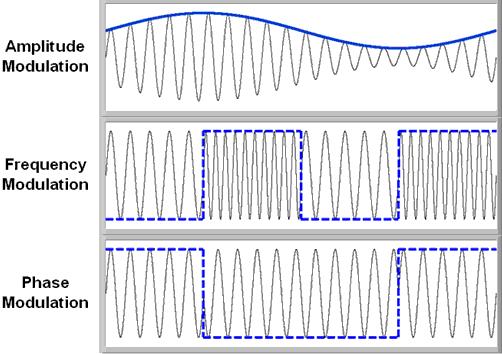
Courtesy National Instruments


There are many more but these are the basics.  So we would have to come up with a conversion scheme for our digital stream.  You would think this is the easy part (and in cases is) but the issue that arises is bandwidth.

Many times we must keep signals within certain FCC bandwidths.  For example, I may have been allocated a certain bandwidth from 45.6MHz to 46.2MHz.  If I transmit outside this range, I'm in trouble.  So modulation will usually be based around this constraint first.  After transforming the digital signal we would then modulate the signal onto a 46MHz waveform to stay within bounds.  (Of course this is simplified)

Regardless, this is the basics of modulation from a systems point of view.  From the circuits point of view we use mixers, PLLs, and oscillators.

Demodulation is just the inverse of this process.  We will generally filter out the frequency we are looking for (so we don't get other garbage from the air) and reverse the process to retrieve the original signal.

That's it.  Not much more about modulation/demodulation I can tell.  It's crazy, I use it often where I work as an RF engineer, but I know so little...(I am new to the industry though).

Hope this is somewhat useful.

------------------------
Justin Coulston
justin.coulston@gmail.com

Tuesday, March 30, 2010

Signal Processing: Receiving Wireless Signals

Introduction
This is my first of many Signal Processing blogs.  I am writing this specifically in response to danong's interest in signal processing.  If there are any interests in particular, please let me know and I'll be sure to write something about the topic.  If I know nothing, I'll talk to some of the experts I work with and learn about the topic.  Just leave me a comment, or start following my blog.

What is Signal Processing?
Based on Wikipedia "Signal processing is an area of electrical engineering, systems engineering and applied mathematics that deals with operations on or analysis of signals, in either discrete or continuous time to perform useful operations on those signals."  I can more or less agree with this statement.  But the extent in which signal processing encompasses the Electrical Engineer is extraordinary.  In order to perform signal processing there are a large number of skills involved including RF/Microwave technology, digital hardware technology, software integration technology, and systems architecture technology/knowledge (just to name a few).  With a combination of these, can signal processing really be done.

I will admit that the least important of these is RF/Microwave technology (my industry) but only to an extent.  Most hobbyists and electrical engineers only work in low frequencies (up to 10MHz).  There are exceptions of course, but it's fairly easy to work with signal processing at low frequencies.  When you start working with higher frequencies, sometimes in the GHz range, or wireless technology, an understanding of RF becomes vital.

So today, I'm going to expand on the RF side of things (assuming you're working in a relatively high frequency application (>100MHz).

Basic components to receive an RF signal
I have included a simple block diagram of the essential components required to receive an RF signal.  It should be relatively straight forward to understand.


  • Antenna: The antenna is where the data comes in.
  • Protection Circuitry: This circuitry protects the rest of the components, say from lightning or overbearing signal strength.
  • Filter Network: The filter network separates your signal from other stray signals in the air.  It can comprise of 10 different filters that use switches (like in some radio systems) or an adjustable filter for different frequencies, or just a single frequency filter.
  • Limiter: Typically, you will want to use a limiter to protect your amplifier.  Most of the time an amplifier will be limited by input power.  This stage can be ignored if you limit the protection circuitry enough.  But there may be a lot of loss in the filters so it really depends on design.
  • Amplifier: This is the stage where you drive the signal to an appropriate level.  It higher-end systems, use an LNA (low-noise amplifier) to drive this stage.  It's helpful to keep as little noise from incurring in the process.
  • Processing Circuit: This stage really is the bulk of what is going on in a system.  This stage can include a demodulator, FPGA to analyze the signal, etc.  Really, this is where you decipher the RF signal into usable data.
That's about it.  It's simple enough.  If you have these basic stages, you can receive about any signal safely.  Keep in mind that extensive design can go into each stage.  If you have specific questions, be sure to ask me.  Follow me and comment!

--------------------
Justin Coulston
justin.coulston@gmail.com